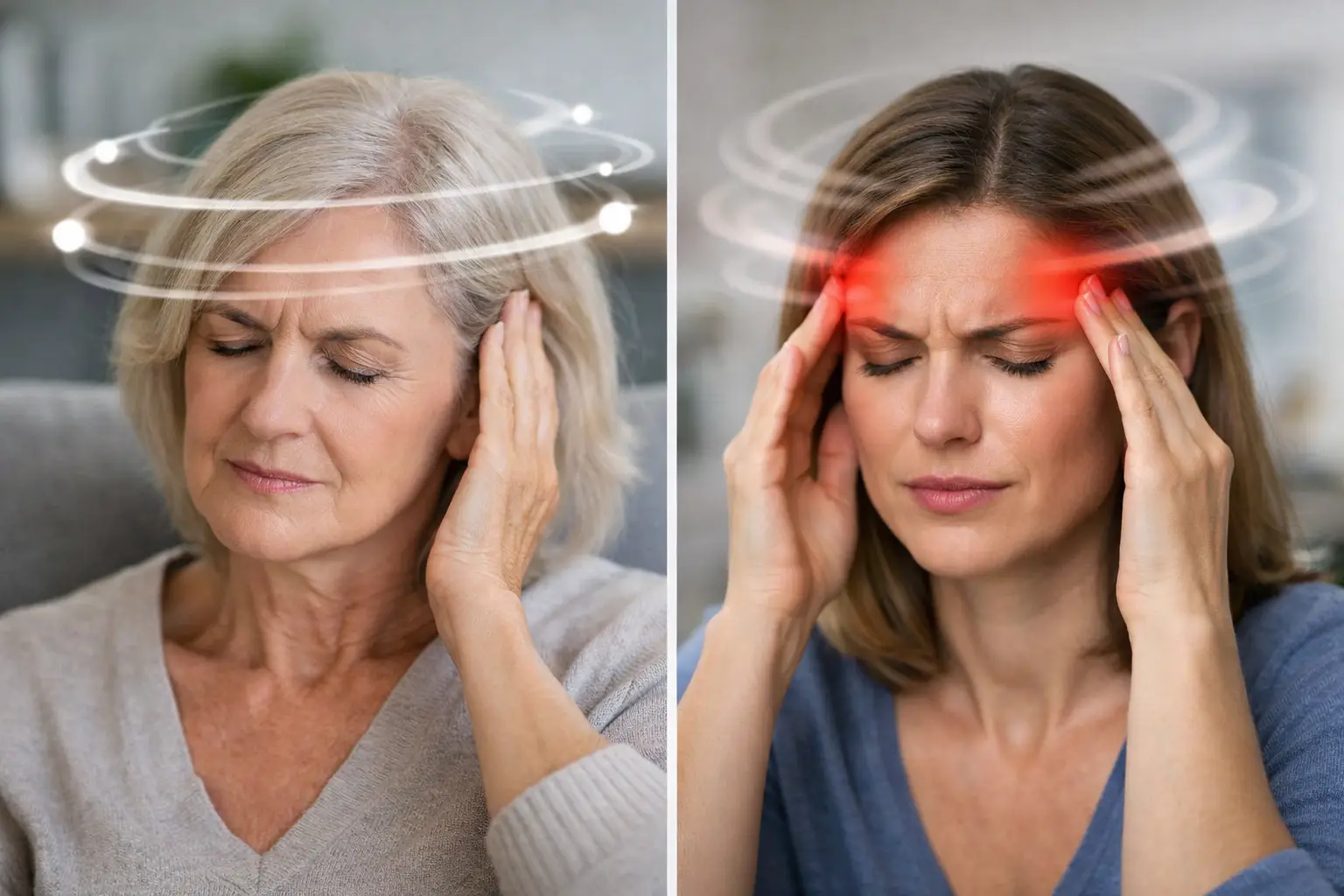
Vertigo (BPPV) vs Vestibular Migraine: Key Differences
One patient says, “The room spins when I roll over in bed.” Another says, “I feel off balance for hours, especially after poor sleep or stress.” Both are describing dizziness, but they may be dealing with very different conditions. When it comes to vertigo (BPPV = Benign Paroxysmal Positional Vertigo) vs vestibular migraine, the distinction matters because the right treatment depends on the right diagnosis.
Vertigo (BPPV) and vestibular migraine are two of the most common causes of vertigo seen in clinical practice. They can overlap enough to cause confusion, especially if symptoms come and go or if someone has already been told they have “just vertigo”. But they are not the same condition, and a careful assessment usually reveals important differences. At Metro Physiotherapy located near Town Hall and Gadigal Station on Pitt Street in the Sydney CBD, we see these conditions everyday. In fact, 70% of our patients come in with some degree of dizziness. So it is an everyday thing for us. Yes it is your first time experiencing these symptoms so we take the time to properly and accurately assess and explain what really is going on.
Vertigo (BPPV) vs vestibular migraine: why they get mixed up
Both conditions can cause spinning, motion sensitivity, nausea and a sense that your balance is not quite right. Both may be triggered by head movement. Both can also leave people feeling anxious about driving, working, exercising or simply turning over in bed.
The problem is that “dizziness” is a broad term. For one person it means true spinning vertigo. For another it means floating, rocking, light-headedness or visual discomfort in busy environments. Those details are not minor. They often point us towards the underlying cause.
BPPV, or benign paroxysmal positional vertigo, is a mechanical inner ear problem. Tiny crystals that normally sit in one part of the inner ear become displaced and move into a semicircular canal where they should not be. When the head changes position, those crystals shift and trigger a brief but intense spinning sensation.
Vestibular migraine is different. It is a neurological condition linked to the migraine process. Some people get headache with it, but not everyone. The main issue is that the brain becomes more sensitive to vestibular input, motion and sensory information. That can create vertigo, imbalance and motion intolerance even when the inner ear itself is not mechanically blocked.
What BPPV usually feels like
BPPV tends to be very position-specific. People often say the spinning starts when they roll over in bed, lie back, look up, bend forward or get out of bed quickly. The vertigo is usually brief, often lasting seconds rather than hours, though the unsettled feeling afterwards can linger longer.
A classic pattern is a strong spinning episode with a particular movement, followed by relative calm if the head stays still. Some people feel nauseous, and some avoid certain positions because they know exactly what will set it off.
BPPV usually does not cause ongoing migraine-type sensory sensitivity. It also does not typically cause symptoms like visual aura, marked sensitivity to light or sound, or dizziness that persists for much of the day without clear positional triggers. That said, real life is not always textbook. Someone can have BPPV and another vestibular issue at the same time.
What vestibular migraine usually feels like
Vestibular migraine can be much more variable. Vertigo may last minutes, hours or sometimes longer. Some people feel spinning. Others feel rocking, swaying, head pressure, disorientation or a strong sense of motion sickness. Busy supermarkets, scrolling on a screen, fluorescent lighting, poor sleep, skipped meals, stress or hormonal changes may all play a role.
Unlike BPPV, vestibular migraine is often less tied to one exact movement and more influenced by the broader state of the nervous system. A quick head turn might aggravate it, but so might fatigue, neck tension or a migraine trigger. Some people have a clear migraine history. Others only realise the connection after a detailed discussion about headaches, sinus-like pressure, visual sensitivity or previous episodes labelled as migraine.
Not every vestibular migraine episode comes with headache. That is one reason it is missed. If you are waiting for a severe one-sided headache before considering migraine, you can overlook a lot of vestibular presentations.
The key differences in bppv vs vestibular migraine
The shortest way to think about bppv vs vestibular migraine is this: BPPV is usually a brief, position-triggered mechanical problem in the inner ear, while vestibular migraine is a broader migraine-related disorder involving sensory processing and brain sensitivity.
Duration is one clue. BPPV tends to produce short bursts of vertigo with specific positional changes. It starts within 10 seconds of cha going your head position and lasts up to 30 secinds. Vestibular migraine more often lasts longer and may fluctuate across the day.
Triggers are another clue. BPPV is strongly linked to lying down, rolling, looking up or bending. Vestibular migraine can be triggered by movement too, but often also by sleep disruption, stress, hormonal shifts, certain foods, visual overload or a history of migraine.
Associated symptoms matter as well. Vestibular migraine is more likely to come with headache, light sensitivity, sound sensitivity, visual discomfort, brain fog or motion intolerance. BPPV is more likely to feel like a sharp spin with one head movement and then settle once the position changes back.
Still, there are grey areas. A person with migraine can develop BPPV. Someone with BPPV may feel washed out and unsteady afterwards. That is why self-diagnosis can be unreliable.
Why assessment matters
If dizziness keeps returning, the main goal is not just symptom relief. It is identifying what is actually driving it. A proper vestibular assessment looks at the exact triggers, duration, quality of dizziness, migraine history, neck involvement, eye movements and positional testing.
For BPPV, positional tests are essential because they can provoke a characteristic nystagmus, which is an involuntary eye movement that points to the affected canal. That finding helps confirm the diagnosis and guides treatment. Generally, faster eye motion tells us which side and which canal is affected by the dislodged crystals. For vestibular migraine, diagnosis relies more on the overall pattern. The clinician pieces together symptom history, migraine features, vestibular findings and what has or has not responded to treatment. A Physiotherapist who has specifically trained in managing migraine and vestibular migraine often find a particular pattern on examination in the upper cervical spine. And when the upper cervical spine is treated, if will often improve the patient’s symptoms significantly.
This is where experience matters. If someone is treated repeatedly for BPPV without lasting improvement, or if their symptoms do not match the usual pattern, it is worth asking whether vestibular migraine or another cause is part of the picture.
Treatment is different because the cause is different
BPPV is often very treatable with canalith repositioning manoeuvres. These are specific head and body movements designed to guide the displaced crystals out of the affected canal and back to where they belong. When the diagnosis is accurate, treatment can be highly effective, sometimes within one or two sessions.
Vestibular migraine needs a different approach. Management may involve identifying migraine triggers, improving sleep and pacing, reducing sensory overload, addressing neck and jaw contributors where relevant, and using vestibular rehabilitation to settle motion sensitivity and improve balance. Some people also need medical review for migraine medication or broader neurological management.
That difference is why generic advice to “just do the Epley manoeuvre” is not always helpful. If the issue is vestibular migraine, repeated repositioning manoeuvres may do little or may even stir symptoms unnecessarily. On the other hand, if the issue really is BPPV, trying to fix it only with relaxation or general exercises may prolong the problem.
When symptoms do not fit neatly into one box
Not every presentation is straightforward. Some people have episodes that sound partly positional but also have migraine features in the background. Others develop lingering imbalance after BPPV has been treated successfully. In those cases, the question is not which label sounds closest. The question is what combination of factors is keeping the person symptomatic.
This is often where patients feel frustrated. They have seen multiple providers, had their symptoms minimised, or been told everything is normal despite still feeling unsteady. Dizziness is disruptive. It affects work, commuting, exercise and confidence. It deserves a thorough and respectful assessment.
In a clinic with a strong vestibular focus, the process should feel clear. You should understand what is being tested, what the findings suggest, and why a particular treatment plan is being recommended. At Metro Physiotherapy, that kind of clinical precision matters because lasting improvement usually starts with getting the diagnosis right.
When to seek help
If your dizziness is recurrent, strongly affecting daily life, or not improving with basic advice, it is worth being assessed properly. It is also worth seeking urgent medical care if dizziness comes with new neurological symptoms such as weakness, facial drooping, severe difficulty speaking, chest pain, fainting, or a sudden severe headache unlike anything you have had before.
For less urgent but persistent symptoms, early assessment can save a lot of trial and error. The longer dizziness goes on, the more people often start limiting movement, avoiding exercise and becoming hyperaware of every sensation. That response is understandable, but it can make recovery more complicated.
The encouraging part is that both BPPV and vestibular migraine can improve significantly with the right management. The first step is not guessing. It is working out which system is actually driving the symptoms, and then treating that with care, accuracy and a plan that makes sense for your life.