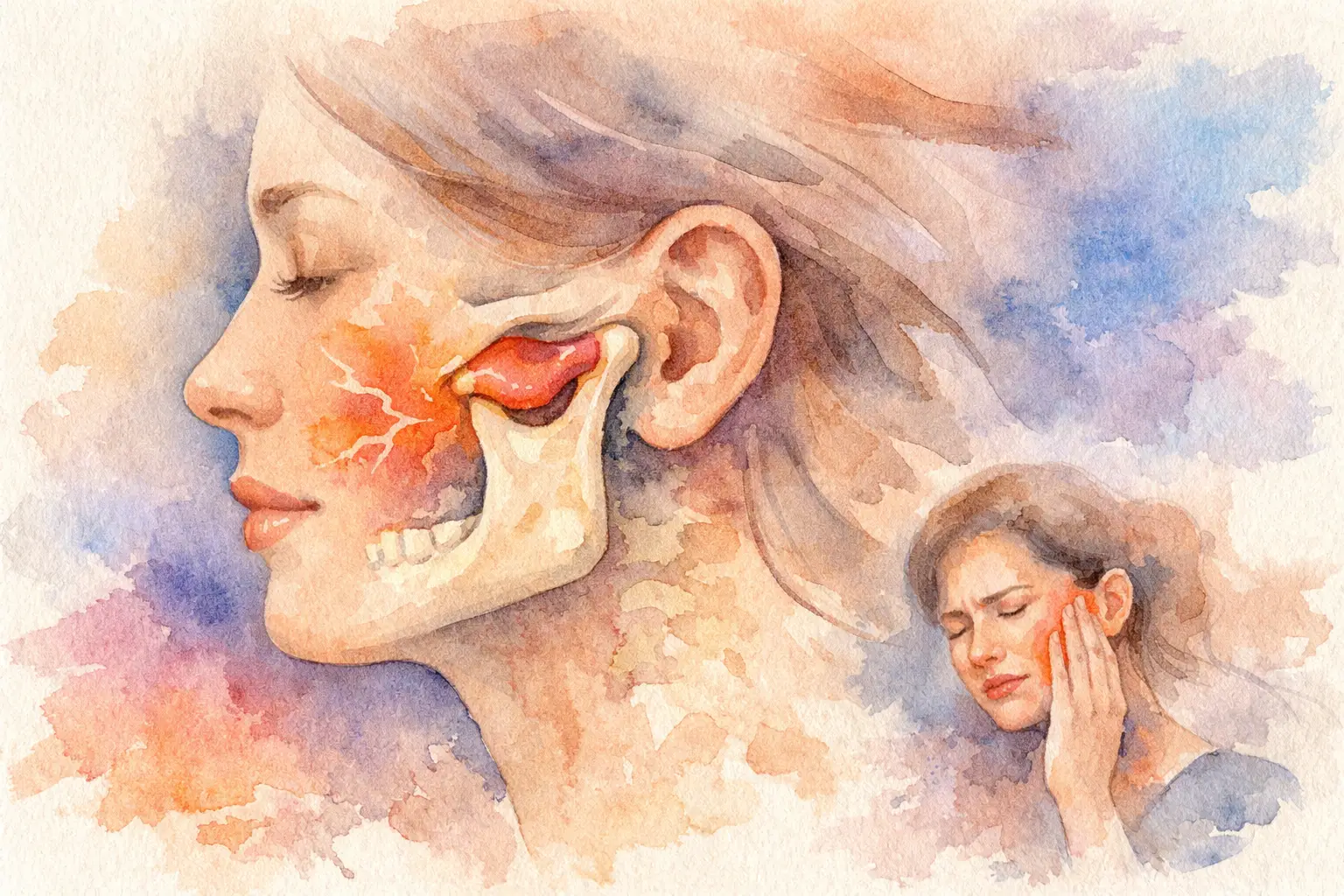
Top Signs of Jaw Disc Displacement
A jaw that clicks once in a while can seem harmless – until it starts catching when you yawn, feeling stiff at breakfast, or giving you pain near the ear by the end of the workday. One of the most common signs of jaw disc displacement is a change in how the jaw moves and feels, especially if that change keeps coming back.
Inside the temporomandibular joint, or TMJ, there is a small disc that helps the joint glide smoothly as you open and close your mouth. When that disc shifts out of its usual position, the movement of the joint can become less efficient, less comfortable, and sometimes unpredictable. For some people this causes a painless click. For others, it leads to locking, pain, headaches, or difficulty eating. I consulted a patient just recently who had been suffering from the jaw clicks and occasional closed locks (where you are unable to open) for half a decade. She started with an oral splint, then botox followed by an arthroscopic washout surgery. Unfortunately for her, the symptoms of clicks and closed locks still kept occurring despite all these treatments. When she gets her closed locks, it is helpful to take valium. For her, it usually took about half an hour to unlock. Fortunately for her, she had one way to get out of the locked state. But still, valium was not stopping her closed locks from ever coming back. She wanted more long term solution and that is why she was referred to me from her dentist.
What jaw disc displacement actually means
The TMJ sits just in front of the ear and connects the lower jaw to the skull. In fact, only a 2mm bone wall separates your ear hole from the jaw joint. The disc is a small pad of fibrocartilage that acts a bit like a cushion and guide within the joint. Ideally, it moves in a coordinated way with the jaw.
Jaw disc displacement means the disc is no longer sitting in its usual relationship with the jaw joint during movement or at rest. In some cases, the disc returns to a more normal position as you open your mouth. In other cases, it does not. That distinction matters because symptoms can be quite different.
When the disc is displaced with reduction, it often clicks or pops as the jaw opens and sometimes again as it closes. When it is displaced without reduction, the jaw may feel blocked, and mouth opening can become more limited. Neither pattern should be diagnosed from sound alone. A proper assessment looks at movement, pain behaviour, muscle involvement, joint mechanics, and your broader symptom picture.
Common signs of jaw disc displacement
The clearest signs of jaw disc displacement usually show up during ordinary tasks – talking, chewing, yawning, brushing your teeth, or having a long day of meetings where your jaw stays tense without you realising.
Clicking, popping, or clunking in the jaw
This is often the symptom people notice first. A click near the ear during opening or closing can suggest the disc is moving abnormally and then relocating as the jaw continues to open. If the click is consistent and happens at a similar point in the range of movement each time, that can be clinically meaningful.
That said, not every click is a problem that needs treatment. Some people have a clicking jaw with no pain, no locking, and no limitation. Others have a click that gradually becomes more frequent, louder, or associated with discomfort. The sound itself matters less than the whole pattern.
Jaw locking or catching
If your jaw feels stuck, catches partway through opening, or occasionally locks in an open or closed position, this deserves attention. Patients often describe this as needing to wiggle the jaw to get it moving again or feeling nervous about yawning fully in case it jams.
This can happen when the disc interferes with smooth joint motion. Sometimes the locking is brief and intermittent. Sometimes it progresses to a more persistent reduction in opening. Either way, it is a sign the joint is not moving well.
Limited mouth opening
A reduced ability to open your mouth is one of the more important signs of jaw disc displacement, particularly when the disc no longer reduces during opening. You might notice trouble fitting in a sandwich, difficulty at the dentist, or a sense that the jaw simply stops before it should. As a general guide, you would need 38mm mouth open (two fingers width vertically) and keep it open for 2 minutes before you feel comfortable to have your back teeth cleaned or treated.
Normal opening varies between individuals, so there is no single number that tells the whole story. What matters is whether your opening has changed, whether it is painful, and whether the movement is straight and smooth or deviates to one side.
Pain in front of the ear or around the jaw joint
Pain from the TMJ is commonly felt just in front of the ear, though people often describe it more broadly as ear pain, cheek pain, or pain along the side of the face. It may come on during chewing, after a tough meal, first thing in the morning, or late in the day after clenching.
Disc displacement does not always cause pain, and pain is not always coming from the disc itself. The surrounding joint tissues (such as capsules, ligaments) and jaw muscles can become irritated as they try to compensate for altered mechanics. This is why accurate assessment matters. Two people can have similar sounds but very different pain drivers.
A jaw that shifts to one side on opening
If the jaw tracks off to one side when you open, especially if it repeatedly veers the same way, this can point to altered joint movement on that side. Some deviation is subtle and only obvious in a mirror. In other cases, the movement feels awkward or uneven.
A temporary deviation that corrects as you open further may be seen in one pattern of disc displacement. A deviation that stays to one side, particularly with reduced opening, may suggest the joint is not translating normally. Again, this needs clinical interpretation rather than guesswork. Jaw joints move in 3 dimensions and there is one on each side. 1 Open – Close, 2 right translation – left translation, 3 protrusion – retrusion. So using 3 dimensional motions, we create rotationally motions of bottom teeth on the top teeth to grind food. I often get patients to imagine horse eating carrot. They magnify what we humans do and you can easily observe their rotationally chewing motions.
Other symptoms that can sit alongside it
Jaw disc displacement rarely exists in isolation. Many people also have overactive jaw muscles, neck stiffness, headache, grinding, or a history of clenching. The result is a symptom picture that can look broader than just a jaw issue.
You may notice tenderness in the temples, tiredness in the face when chewing, headaches around the temples or behind the eyes, or a sense of pressure near the ear. Some people also report dizziness or neck tightness, though these symptoms are not specific to disc displacement and should not automatically be blamed on the jaw.
This is one of the reasons generic advice can fall short. If the main driver is joint mechanics, treatment needs to reflect that. If muscle overload, posture, sleep habits, airway factors, or migraine are playing a large part, management may need to be broader.
When the signs of jaw disc displacement are more urgent
Not every clicking jaw is urgent, but a few patterns should prompt assessment sooner rather than later. If your mouth opening has suddenly become restricted, your jaw has locked and not returned to normal, or eating is becoming difficult, it is worth getting the joint examined properly.
The same applies if pain is escalating, symptoms are becoming more frequent, or you are starting to avoid certain foods, yawning, singing, or dental care because the jaw feels unreliable. Small changes in function can become bigger limitations if the problem keeps being irritated.
If you also have fever, facial swelling, recent trauma, numbness, or other symptoms that do not fit a straightforward TMJ presentation, you may need medical review to rule out other causes.
Why self-diagnosis often misses the full picture
It is very common for people to search their symptoms after hearing a click and assume they have a displaced disc. Sometimes they are right. Often the story is more complicated.
A clicking sound can occur without significant dysfunction. Pain near the jaw can come from the joint, the muscles, the neck, the teeth, or referral from headache disorders. Limited opening can be due to disc displacement, but also muscle spasm, guarding, joint irritation, or post-dental factors.
That is why a useful assessment by an experienced TMJ physiotherapist does more than label the problem. It looks at how the jaw opens, closes, deviates, loads, and responds to palpation. It considers what your symptoms do over a day, what aggravates them, and whether clenching, sleep, posture, stress, or neck dysfunction are contributing.
What treatment depends on
Treatment for disc displacement is not one-size-fits-all. It depends on whether the disc is reducing, whether the joint is painful, how limited the opening is, how long symptoms have been present, and what else is feeding the problem.
For some people, education, activity modification, and specific jaw exercises can settle symptoms well. For others, hands-on treatment, muscle down-training, and management of associated neck and headache factors are important. If there is a strong habit of clenching or grinding, that also needs to be addressed. The goal is not just to quieten the click. It is to improve function, reduce strain, and help the joint tolerate daily life again. As mentioned above, if clenching or grinding (bruxing) at night during sleep is the reason for jaw clicking, in order to stop clicking for good, the identification of the reason for clenching or grinding is paramount. The list of reasons are many but a few of them are;
- lack of oxygen during sleep due to sinus issues
- sleep apnoea
- gastro oesophageal reflux (GORD or GERD)
- poor chin poke posture
- thyroid issues
- iron deficiencies, or
- medication use such as SSRI drugs
Importantly, not every disc displacement needs the disc to be put back into a perfect position to achieve good outcomes. Many patients do very well when pain settles, movement improves, and the jaw becomes reliable again, even if some noise remains.
Signs of jaw disc displacement that are worth checking
If your jaw is clicking more often, opening less, shifting to one side, locking, or causing pain near the ear, it is worth having it assessed rather than waiting for it to sort itself out. At Metro Physiotherapy, that assessment is focused on understanding exactly which structure is involved and what is most likely to change your symptoms in a meaningful, lasting way. I would greatly appreciate it if you would let me assess and treat your jaw. I am located in Sydney CBD near Town Hall (2 minute walk), and Gadigal Station (1 minute walk), at 250 Pitt Street Sydney 2000.
A noisy jaw is not always serious, and a painful jaw is not always a disc problem. But when your jaw starts changing how it moves, that is usually your cue to pay attention. Getting the right diagnosis early can make eating, talking, working, and simply getting through the day feel much easier again.