What Causes Jaw Clicking Pain?
That click when you chew, yawn or open wide often seems harmless – until it starts coming with pain, tightness or headaches. If you have been wondering what causes jaw clicking pain, the short answer is that the jaw joint is usually not moving as smoothly as it should, and there are several reasons that can happen.
The jaw is a complex system, not just a hinge. It is a composite motions of spin and glide called ginglimo-arthrodial joint. It spins for the first 70% of opening your mouth and then the joint glides forward for the last 30% of your mouth opening fully. It involves the temporomandibular joint, or TMJ, the small disc inside the joint, the surrounding muscles, the neck, and even habits such as clenching or grinding. When one part is overloaded or not coordinating well, clicking and pain can develop together.
What causes jaw clicking pain in the TMJ?
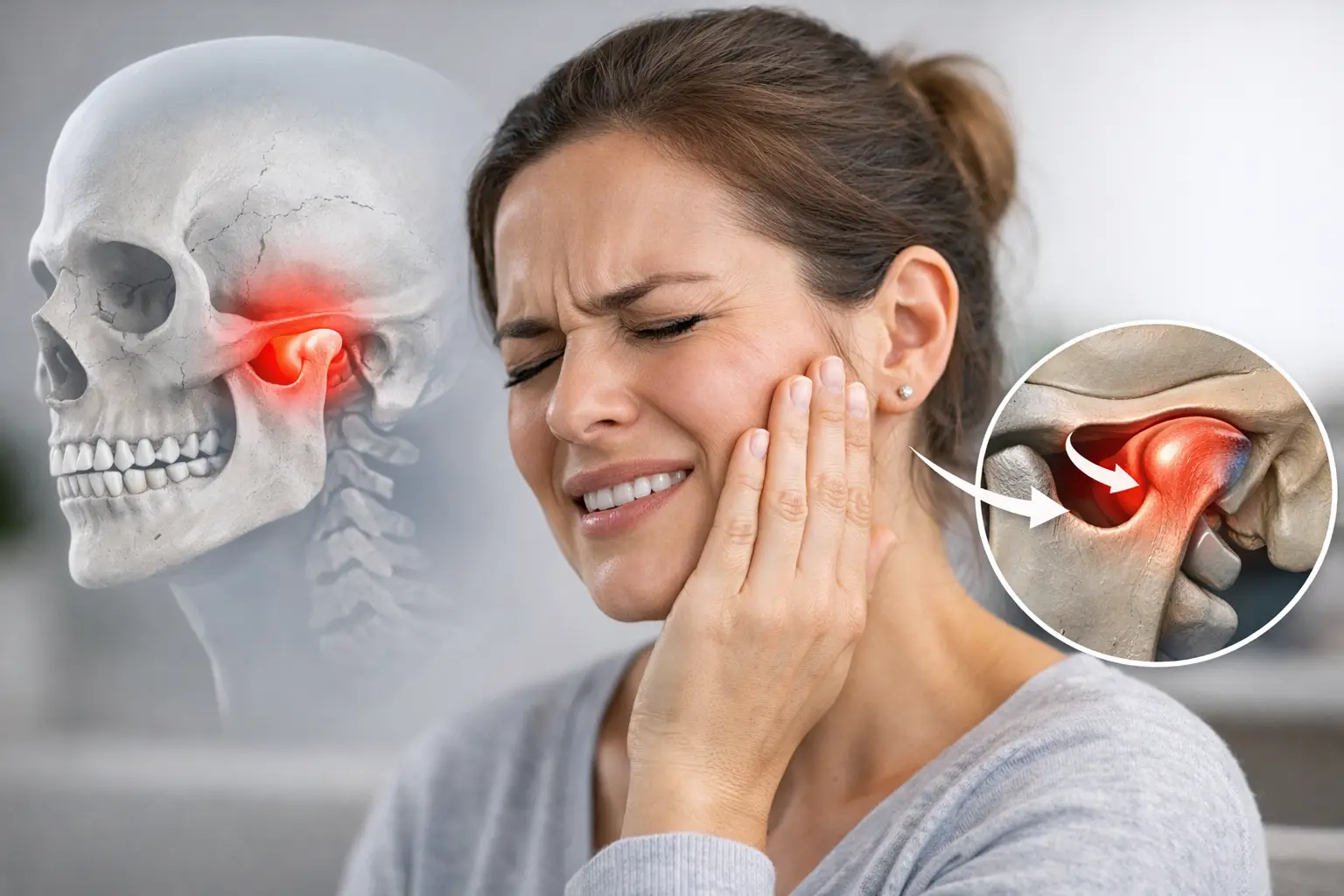
In many cases, the click comes from the disc inside the temporomandibular joint. This disc acts like a cushion between the jaw bone and the socket. Ideally, it moves with the jaw in a controlled way. If it starts slipping slightly out of position, the jaw may click as the disc moves back into place during opening or closing.
That alone does not always cause pain. Some people have a painless click for years. That is because the jaw joint disc (articular disc) is not innervated directly (does not have any nerve supply directly). Pain tends to appear when the joint tissues become irritated and possibly imflammed when the surrounding muscles tighten up to protect the area, or when repeated strain keeps aggravating the problem by impinging the tissues such as retro-discal lamina. Retro-discal lamina is a structure that consists of layers of tendon, nerve and blood vessels that are attached to the back of the disc. When the click occurs, the disc moves out of the jaw joint, then the retrodiscal lamina gets pulled into the jaw joint in stead of the disc. Then it may stay there due to possibly tight muscles tensioning the jaw joint. When you eat or talk, then the retrodiscal lamina gets jammed and pinched inside the jaw joint like as if you have jammed your finger in the doorway causing significant impingement pain and subsequent inflammation doubly causing more pain. This can continue for weeks and months if not assessed and diagnosed and then treated by someone with deep knowledge about jaw joint. The extent of the pain is variable due to other co-existing factors such as age-related hormonal changes, joint conditions, breathing patterns and posture amongst other factors. Some factors are modifiable factors and those are the ones we will focus on identifying and make it better so that your jaw will be on its way to recovery. Jaw joint by nature has poor blood supply and therefore it takes months and years for things to worsen and takes weeks and months to improve as well. We always have to respect the biology of healing and jaw joint certainly has unique anatomy that determines its course and mechanism of injury and recovery.
This is why two people can have a very similar jaw click but very different symptoms. One may barely notice it. The other may feel pain when eating, stiffness first thing in the morning, or tension spreading into the temple, ear or neck.
The most common reasons a jaw clicks and hurts
Disc displacement
This is one of the most common mechanical causes. The disc sits slightly forward or to the side instead of staying centred. As you open your mouth, the jaw can catch and then click as it moves over the disc.
If this has been happening repeatedly, the tissues in and around the joint can become inflamed. That is when clicking becomes painful rather than just noisy. Sometimes there is also a feeling that the jaw momentarily locks, shifts to one side, or does not open evenly.
Clenching and grinding
Clenching during the day or grinding at night can overload both the joint and the muscles around it. Many busy professionals do this without realising it, particularly during stress, focused work, exercise, or sleep.
Over time, that extra load can sensitise the joint, tighten the chewing muscles, and make a pre-existing click more painful. People often notice this pattern alongside morning jaw soreness, headaches on waking, tooth sensitivity, or fatigue around the face.
Muscle tension and poor jaw control
Not all jaw pain is purely a joint problem. In some cases, the clicking is mechanical, but the pain is more muscular. The masseter, temporalis and pterygoid muscles can become overactive and tender, especially if you chew gum often, eat a lot of hard foods, or hold tension in the jaw through the day.
When the muscles are not coordinating well, the jaw can track unevenly. That poor movement control can contribute to clicking and make the area more painful. This is one reason treatment should not focus only on the joint itself.
Trauma or overload
A direct hit to the jaw, prolonged dental work, a difficult yawn, biting into something unexpectedly hard, or even extended mouth opening during medical or dental procedures can flare the TMJ. Sometimes the onset is obvious. Other times, symptoms appear gradually after the area has been irritated.
In these situations, the click may begin because the joint mechanics change after the overload. Pain can linger if the tissues do not settle properly or if you keep compensating with tight muscles.
Arthritis and joint irritation
Some jaw joints develop degenerative change, especially with age, long-term overload, previous trauma, or chronic dysfunction. Arthritic change can affect how smoothly the joint surfaces move and may create clicking, grating, stiffness and pain.
That does not automatically mean the condition is severe. Mild degenerative change is not unusual, and symptoms vary widely. The key question is whether the joint is irritated and how much it is affecting daily function such as eating, talking or yawning.
Neck and headache-related factors
The jaw does not work in isolation. Neck dysfunction, posture-related strain, and certain headache patterns can increase muscle tension around the face and jaw. For people who spend long hours at a desk, this overlap is common.
A forward head posture does not directly “cause” TMJ clicking on its own, but it can add load to the system. If your neck is stiff, your upper shoulders are tight, and you are clenching without noticing, the jaw often pays the price.
When clicking is not just clicking
A painless click is not always an emergency, but pain changes the picture. If your jaw clicking is accompanied by locking, reduced opening, pain with chewing, headaches, ear discomfort, or facial tension, it is worth getting assessed.
The reason is simple: jaw pain can come from more than one source at once. You may have a disc issue plus muscle overactivity. Or clenching plus neck-related tension. Without a proper assessment, people often end up treating the wrong thing, or only part of the problem.
This is also why online advice can be hit and miss. General tips such as “just relax your jaw” or “wear a splint” may help some people, but not everyone. Splint will always protect your teeth but it does not stop clenching or grinding at night all together. As a result, some people end up wearing the splint for a very long time like weeks, months and years. Sometimes this is unavoidable especially if one uses SSRI medication and one of the side effects is clenching and grinding and one needs the medication to keep things under good control. It depends on whether the main driver is joint irritation, muscular overload, movement dysfunction, sleep-related bruxism, or a combination.
What causes jaw clicking pain to flare up?
Even if the underlying issue has been there for a while, symptoms often spike during certain periods. Stress is a common factor because it tends to increase clenching and muscular tension. Poor sleep can do the same. So can long days of talking, chewing tough foods, singing, dental work, or even returning to the gym with heavy bracing through the jaw.
Some people also notice that migraines or headaches coincide with worse jaw symptoms. That does not mean the jaw is causing every headache, or that every headache comes from the jaw. But there is often overlap, and in clinical practice these patterns need to be considered together rather than in isolation.
How jaw clicking pain is properly assessed
A good assessment looks beyond the noise in the joint. The real aim is to work out what structure is involved, what is driving the overload, and what is keeping it going.
That usually includes looking at jaw opening and closing, whether the jaw deviates to one side, how wide it opens, whether there is pain in the joint or muscles, and whether clenching or chewing reproduces symptoms. The neck, headache history, sleep habits, stress patterns, and oral behaviours also matter.
Sometimes imaging is useful, but not always. Many jaw problems can be assessed clinically first. Imaging tends to be more relevant if symptoms are severe, if the jaw is locking, if there is a significant trauma history, or if progress is not following the expected path.
At Metro Physiotherapy, this kind of detailed assessment is central to treatment planning because lasting change usually depends on understanding the specific pattern, not just naming it TMJ.
What helps when your jaw clicks and hurts?
Treatment depends on the cause. If the joint is irritated, reducing aggravating load is often the first step. That may mean temporarily avoiding very hard or chewy foods, limiting gum chewing, and being mindful of habits such as resting your chin on your hand or clenching at the desk.
If muscular tension is a major factor, hands-on treatment, targeted exercises, and strategies to reduce parafunctional habits can be very effective. Where jaw control is poor, retraining the way the jaw opens, closes and rests can make a real difference.
If neck dysfunction is contributing, it makes little sense to ignore it. This is one of the reasons a physiotherapy approach can be useful. The jaw, face, head and neck often need to be managed as one connected system. When looking at jaw anatomy, jaw joint is formed between two bones; temporal bone (side skull bone) and mandible (lower part of the jaw that houses bottom teeth). So if your neck is influenced by posture and posture is about your head position, head position improvement immediately indicates temporal bone position improvement. This means jaw is already 50% (other 50% is mandible position) better in how jaw joint should move! So put simply, posture improvement means neck, headache, and jaw improvement!!
For some people, dental input is also appropriate, particularly if significant bruxism, tooth wear, or bite-related concerns are involved. Good care is not about one profession claiming the whole problem. It is about identifying the right contributors and addressing them properly.
When should you seek help?
If the clicking is painful, getting worse, limiting your ability to eat or yawn, or accompanied by headaches, locking or ear-area discomfort, it is sensible to have it checked. The earlier the issue is assessed, the easier it often is to calm things down before compensation patterns become more stubborn.
You do not need to wait until the jaw fully locks or the pain becomes constant. Persistent clicking with pain is enough reason to seek an accurate assessment. As stated earlier, Jaw disc is not innervated and does not have any nerve to tell you any pain until it is really inflamed or irritated in the surrounding tissues.
Jaw problems can be frustrating because they sit in that grey area between “maybe it will settle” and “this is affecting my day.” The good news is that jaw clicking pain is often treatable when the real driver is identified. A careful assessment, a clear diagnosis and a plan tailored to your pattern can shift things in a much more meaningful way than just trying to put up with it.
We are located on Pitt Street in Sydney city near Town Hall about 2 minute walk and Gadigal station (1 minute walk). Hope to see you soon and let me hear your story.